ShowIT2019
by Michal Tinthofer on 08/02/2019I would like to say thank you for attending my presentations on this year ShowIT.
Read moreExecutive summary: This case explains how a severe HADR_SYNC_COMMIT spike in a synchronous-commit SQL Server Always On Availability Group was traced to a degraded and unintended network path rather than to SQL Server query processing itself. The investigation combined AG metrics, controlled commit-latency testing, Extended Events, and infrastructure validation to prove the bottleneck and confirm that the subsequent network redesign resolved the observed issue.
.png)
In a synchronous-commit Always On Availability Group, HADR_SYNC_COMMIT represents time spent on the primary replica waiting for confirmation that the relevant log block has been hardened on the synchronous secondary replica. In this case, that wait accumulated into materially increased transaction commit latency, which is why the investigation focused on the full AG synchronization path from log generation through send and remote hardening.
To pinpoint the bottleneck, we implemented a three-tier testing strategy:
The tests showed that the immediate symptom was a severe throughput constraint in the AG synchronization path rather than an inherent limit of the SQL Server engine:
HADR_SYNC_COMMIT wait time was approximately 500,000-800,000 seconds per day, with the nightly window accounting for roughly half of the daily total.
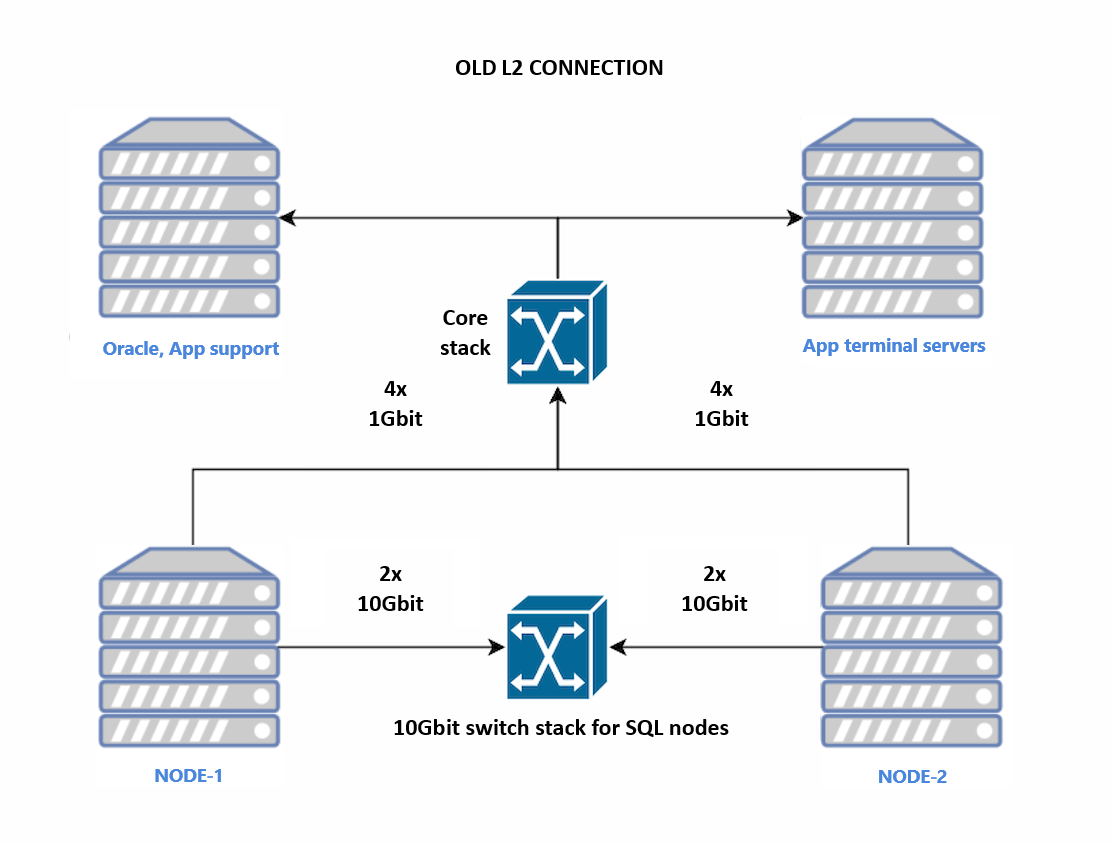
The investigation identified two related infrastructure issues. First, 2 of the 4 paths associated with the secondary node had negotiated down to 100 Mbit/s; those paths were disabled, leaving a temporary 2x1 Gbit/s configuration. Second, because the AG endpoint URLs were defined using FQDNs that resolved to the public IP addresses, and the endpoints were configured with LISTEN_IP = ALL, the AG traffic on port 5022 was established over the public Team #1 interface instead of the intended private Team #2 network. This explained why file-copy testing could use the fast private path while AG traffic followed the slower public path and was observed at approximately 12 MB/s before remediation.
We presented the client with two options:
The client selected Option 2 as part of the data-center core-switch replacement. The 4x1 Gbit/s connections were removed, while the existing 2x10 Gbit/s links to the dedicated Dell switches were retained. An untagged VLAN 2 was configured on those access ports and connected to the new core infrastructure. The design kept node-to-node synchronization on the dedicated switch path while making the cluster reachable by the rest of the infrastructure through the same team.
OLD L2 Network
NEW L2 Network
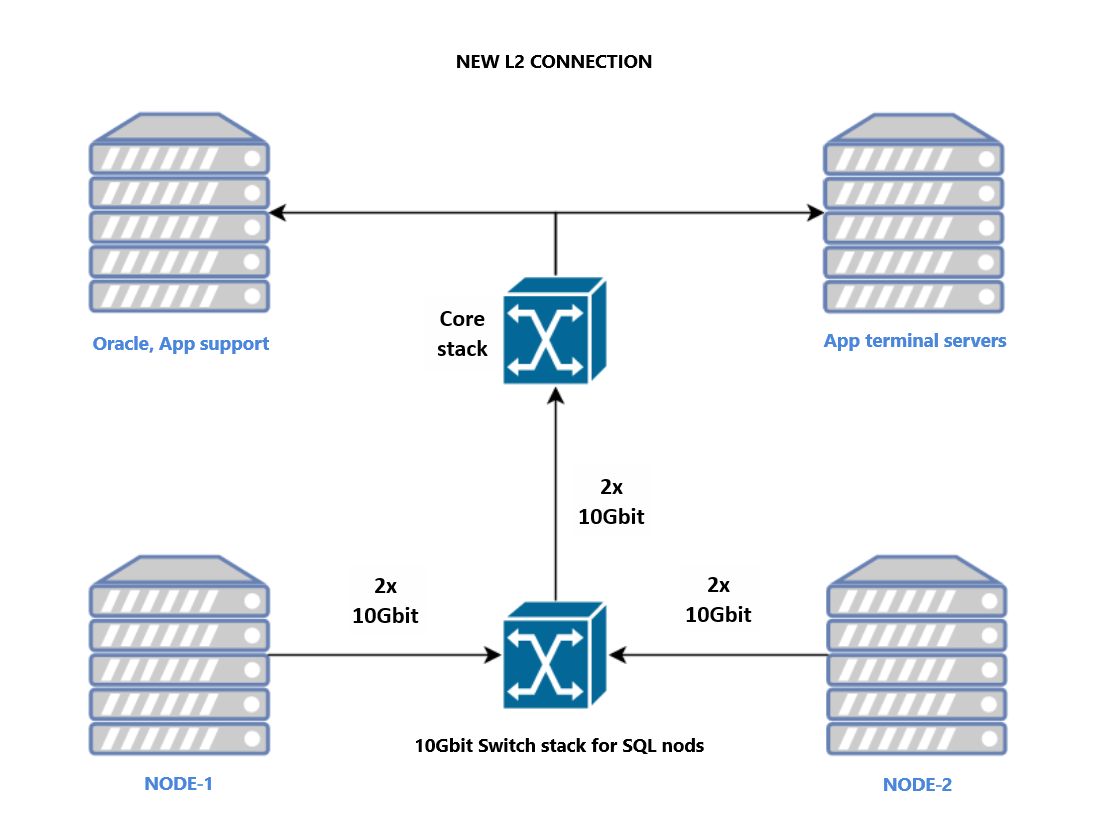
After implementation, the review of wait statistics found no renewed increase in HADR_SYNC_COMMIT waits, indicating that the new switching and network configuration resolved the observed bottleneck. The case demonstrates that SQL Server AG performance depends not only on nominal link capacity, but also on link health, DNS resolution, endpoint configuration, and the actual network path used by port 5022 traffic.
Michal is a technically proficient SQL Server Specialist with a proven track record in resolving incidents and implementing changes within large-scale database infrastructures, ensuring maximum availability of services. Concurrently, as a Digital Content and Marketing Specialist, his priority is building strong online brand identities through strategic communication and creative storytelling. He consistently seeks new ways to enhance digital interaction, believing quality digital communication is key to success in today's connected world.
I would like to say thank you for attending my presentations on this year ShowIT.
Read moreSMT Waits reports – handy overview of what is going on at the server
Read moreRecently I had some issues with SQL server 2008 R2 service pack 1 installation. From first perspective it looks like an issue with corrupted installation package, but true issue was somewhere else. It was a windows installer.
Read more